Ideas for play and discovery
Rush Hour: when moving backward is the only way out
A red car, an exit and a gridlock of obstacles. Explore Rush Hour through planning: predict moves, trace dependencies and escape the jam.
Brain teasers
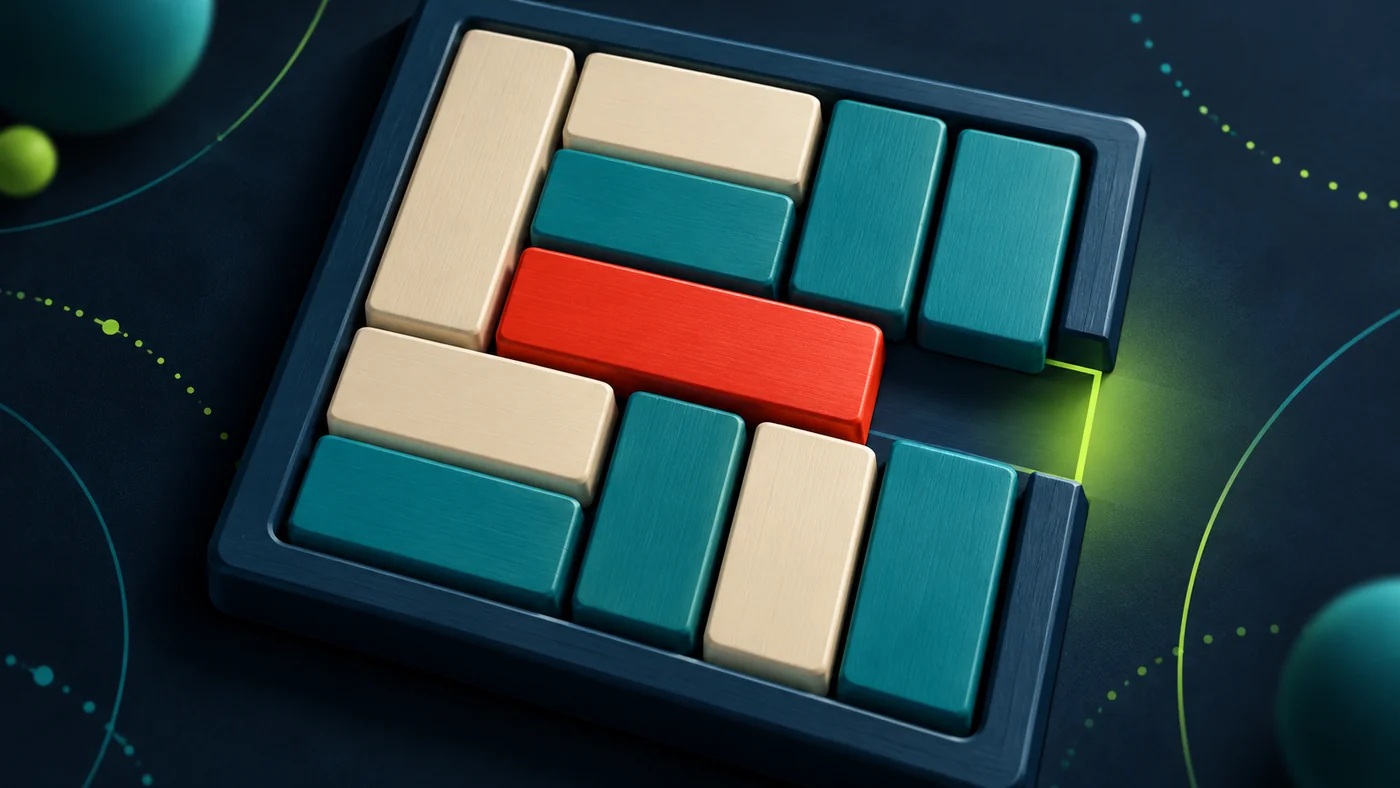
The exit is only a few centimeters away. The red car points toward it, yet it cannot move forward. You slide a truck to clear the way, then discover that another vehicle needs to move first. That one has no room either. Where do you start when everything depends on something else?
ThinkFun’s Rush Hour turns that jam into a planning puzzle. Its appearance is simple; the opportunity lies in choosing advanced challenges and explaining why a move helps, even when it seems to take the car farther from the exit.
A short rule with many consequences
Set up the board from a challenge card and try to get the red car out. Vehicles slide forward or backward along their own orientation; you cannot lift or rotate them to make room. The classic set includes 40 challenges across four levels.
Before following the moves, pick a vehicle blocking the red car. Could it move now? If not, what other move does it need first?
You can explore Rush Hour on Amazon if you enjoy challenges set up on a small board and solved without relying on reflexes or speed.
The visible obstacle may not be the starting problem
Looking only at the space in front of the red car encourages repeated attempts with the same vehicles. Try a different question: what space must become available for the main obstacle to move?
That space may be occupied by a piece you had not considered important. Following the dependency chain changes how you read the board: you are no longer looking for any possible move, but for one that enables another.
In interesting challenges, making room can require a temporary retreat. That raises a useful discussion: how do you distinguish a productive backward move from returning to the same jam?
One approach is to describe the intermediate goal. “I move this car to leave two spaces for the truck” says more than “I’ll try this way.” If you cannot use that space afterward, revisit your hypothesis before piling on more moves.
A planning challenge
Choose an unfamiliar card and copy its layout exactly. Then:
- Point out the red car’s first obstacle.
- Identify the space that vehicle needs to move aside.
- Predict two moves before touching the pieces.
- Make them and check whether they enabled the step you expected.
If you get stuck, rebuild the starting position and note which decision you changed. Solving after many attempts can be entertaining; understanding which attempt helped gives you an idea to carry into the next challenge.
You can also share one board with a partner. Alternate between proposing moves and asking “what does that move enable?” This is a shared activity around a single-player puzzle, rather than an official competitive mode.
What happens when you already know the solution?
Returning to a card is no longer the same mystery if you remember its route. You can still explain the sequence, review unnecessary moves or reconstruct it after a break, but that is not equivalent to a new challenge.
Think of the set as a finite collection of problems. If you want to invent layouts, remember that an improvised arrangement can be impossible: filling the board randomly does not guarantee an escape.
Choose the version for the challenge
For this approach, look for classic Rush Hour with progression to expert. My First Rush Hour and Rush Hour Junior are different products and do not automatically offer the same difficulty. A box’s minimum age does not tell you how engaging its advanced levels will be.
Before comparing Rush Hour versions on Amazon , decide whether you prefer discovering solutions alone or discussing plans with someone else. The most satisfying moment may be spotting a dependency that was in front of you all along.